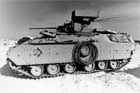
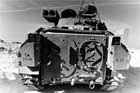
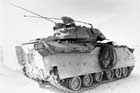
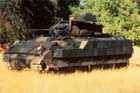
Description:
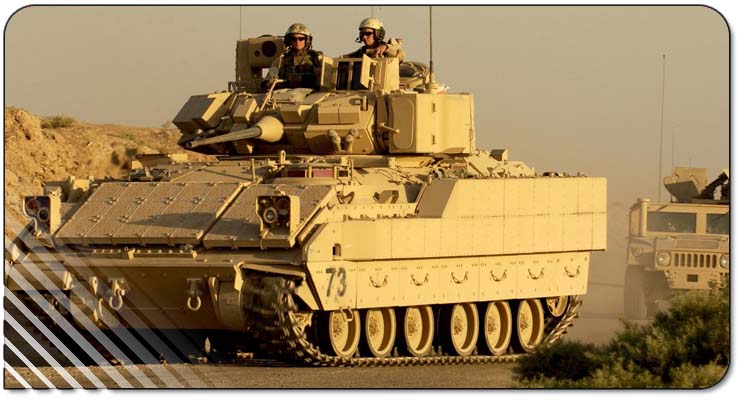
A tracked
vehicle with light armor and armament.
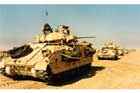
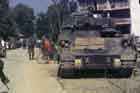
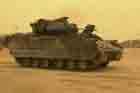
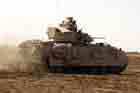
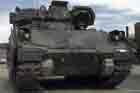
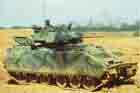
Features: The BFVS is a lightly armored,
fully tracked fighting vehicle that provides cross-country mobility,
mounted firepower and protection from artillery and small-arms fire. It
is used in mechanized infantry and armored cavalry combat. Infantry can
fight from inside the vehicle by using modified M-16 rifles mounted in
firing ports or may dismount from the M-2 version to fight on foot. The
M-3 version is also used by armored cavalry units. The vehicle is armed
with a 25mm cannon, effective against most armored targets, and with
the TOW missile, effective against lightly armored targets out to its
maximum range of 3,750 meters (2.3 miles).
Mobility:
The BFV has excellent acceleration, agility, and cross-country speed of
48 kilometers per hour, with a cruising range of 483 kilometers. The
BFV's mobility provides an ability to move quickly on the battlefield
and work in concert with the M1 main battle tank.
Armor
protection: Through the use of special armorplate materials,
surface slope, and a unique laminate armor system, the BFV has
excellent armor protection for its weight. Even though the BFV's armor
does not compare to that of a tank, the BFV can withstand 14.5-mm
projectiles on all sides; the M2A2 Bradley can withstand projectiles up
to 30-mm.
Mounted
weapons: The vehicle's main armament is a 25-mm fully
automatic, externally powered gun. The BFV's armament also includes a
two-tube antitank missile launcher (TOW), a 7.62-mm coaxially mounted
machine gun, and 5.56-mm firing port weapons. The all-electric, fully
stabilized turret permits accurate fire even when the vehicle is moving
over rough terrain. The turret can also be operated manually.
M242
25-mm gun: The 25-mm gun has three rates of fire--single
shot, low rate, and high rate. It accurately delivers both
armor-piercing and high-explosive rounds. The 25-mm gun using APDS-T
rounds can destroy lightly armored vehicles (BMP, BTR, BRDM). Using
HEI-T rounds, it can destroy unarmored vehicles (trucks, jeeps) and
suppress enemy troops in the open, in built-up areas, or in dug-in
positions.
- (a)
The 25-mm APDS-T round can penetrate lightly armored vehicles. Flank
shots increase the probability of penetration. Maximum effective
range/tracer burnout is about 1,700 meters, but effective fire using
sabot rounds can be achieved by using burst-on-target techniques if
impact of the round can be observed.
- The
25-mm APFSDS-T is a fixed-type, percussion primed round. It consists of
a sabot encapsulated projectile crimped to a steel cartridge case.
Basic operation of this kinetic energy round is the same as APDS-T with
an increase in velocity to about 1,420 meters per second. This round
has increased penetration capabilities as well as tracer burn time,
which allows engagement of targets at longer ranges and with greater
potential to defeat a BMP-2.
- The
HEI-T is excellent for suppressing antitank guided missile crews and
crew-served weapons out to 3,000 meters. Tracer burnout is 2,000
meters, but effective fire can be placed on targets at further ranges
if impact of the round can be observed. HEI-T has a 5-meter bursting
radius that enables this ammunition to be used in both point and area
target engagements.
- The
BFV can carry onboard 900 rounds of 25-mm ammunition; only 300 can be
loaded in the 25-mm ammunition cans. Uploading the weapons system for
the 25-mm takes about 15 minutes. All leaders and gunners must be aware
of the operational impact of using all of the ammunition in the
ammunition cans. As ammunition is fired, 15-round belts can be linked
and loaded in the two ammunition cans in just minutes. If all
ammunition is used, reloading takes 12 minutes because the new
ammunition must be fed directly into the gun. This is difficult to do
while the vehicle is moving.
TOW
launcher: The TOW missile is an accurate antitank weapon from
65 to 3,750 meters. Two TOW missiles are loaded in the turret-mounted
launcher. There is internal space for stowing five missiles, either TOW
missiles or Dragons or a mix. The TOW is best fired at the flank or
rear of tanks at ranges between 1,500 and 2,500 meters to reduce the
flight time of the missile and provide the best attack profile of the
vehicle. Frontal shots should be avoided against tanks. Against lightly
armored vehicles, the range and the target aspect are not as critical
(Table B-2).
The TOW
missile can destroy targets at a minimum range of 65 meters up to a
maximum range of 3,750 meters.
- I-TOW,
an improved TOW missile (BGM-71C), has a 5-inch warhead that includes
an extended probe to provide detonation at a greater standoff distance
from the target, which increases penetration.
- TOW
2 (BGM-71D) has a 6-inch full-caliber warhead that also includes an
extensible probe to enhance penetration, including applique armor.
- TOW
2A (BGM-71E) has all the capabilities of the TOW 2 missile; however, it
contains an explosive charge in the tip of the probe to defeat reactive
armor to allow main warhead penetration.
- TOW
2B (BGM-71F) provides a flyover shoot-down (top attack) capability that
attacks the most vulnerable part of an armored vehicle.
- The
basic TOW, practice (BTM-71A), has an inert warhead and is the standard
training round.
M240C
7.62-mm coaxial machine gun: The 7.62-mm coaxial machine gun
is an accurate and reliable weapon. The main use of this weapon is
against dismounted forces. It can also be used to suppress crew-served
weapons and engage unarmored vehicles and aircraft out to 900 meters
(tracer burnout). The BFV can carry 2,200 rounds of 7.62-mm coax
ammunition--1,400 stowed and 800 ready.
M231
5.56-mm firing port weapons: The basic BFV and M2A1 have six
M231 5.56-mm FPWs--two on each side, two in the ramp. (Figure B-2.) The
M2A2 has only the two ramp FPWs. These weapons provide close-in
protection and suppression out to 300 meters. The M2A1 carries 4,200
rounds of ammunition for the FPWs; the M2A2 carries 2,520 rounds.
Dismounted
Weapons: The weapons for the two squads are two Dragons, six
M249 machine guns, six grenade launchers, six rifles (one M24 sniper
weapon can be provided by the company), one AT4, grenades, and mines.
The vehicle has stowage space for 2,520 rounds of 5.56-mm ammunition
for the rifles and machine guns. This figure does not include the
ammunition the soldiers may carry in the LBE.
Communications:
The BFV's communication system provides for control of mounted and
dismounted operations. Tables B-5 and B-6 and Figures B-3 through B-5,
depict the arrangement of communication equipment and the radio net
configuration within the platoon. As units update their communication
system, they will have the single-channel ground/airborne radio system
(SINCGARS)
Water
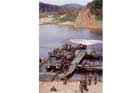
crossing capability: The BFV can ford up to 3.5 feet of
water. With its water barrier erected, the BFV can swim water obstacles
with currents up to 6.4 kilometers per hour. It has a maximum speed of
7.25 kilometers per hour while swimming. Erection of the swim barrier
takes about 15 minutes for the M2A1 BFV and about 25 minutes for the
M2A2. The BFV requires an exit bank slope not greater than 17 percent
and can fire both its 25-mm and 7.62-mm systems while swimming, though
care must be taken not to hit the trim vane or water barrier (cannot
fire below +7 degrees). The 25-mm can be fired in any direction while
swimming; however, the turret should not be traversed because it may
upset the balance of the vehicle.
Smoke
capability: The BFV has onboard smoke capability. It has an
onboard smoke generator and two smoke grenade launchers (four tubes
each). The smoke grenade launchers are fired at the same time, and they
produce a dense cloud of smoke around the vehicle. The launchers are
loaded from the outside. Both the onboard smoke generator and smoke
grenade launcher can be used for obscuring air- or ground-launched
guided missiles. The onboard smoke generator is not effective if the
fuel is JP8, and the temperature is higher than 40 degrees Fahrenheit.
Limited
visibility capability: Using the integrated sight unit in the
thermal mode, the BC and gunner can detect and engage targets during
any visibility condition, day or night. The daysight has normal optics.
The nightsight uses thermal imagery that enables the gunner to see
through most limited visibility conditions. This includes darkness,
light, smoke, light foliage, camouflage, light fog, snow, and mist.
Thermal sights should remain on during combat operations.
The driver
has excellent viewing capability using the AN/VVS-2 driver's night
viewer. This viewer is an image intensification device that allows the
driver to see clearly to his front. Therefore, the driver can handle
his vehicle well on the roughest terrain. Also, during darkness, he can
use the viewer to assist the BC and gunner in sensing rounds fired to
the front. It is, however, prone to whiteout (fadeout) if light is
shined directly at it (for example, spotlights, oncoming headlights,
flashlights, sunlight). When installed, it obscures the
speedometer/odometer. It can be battery powered (6 hours) or run
directly off the vehicle power.
Additional information:
Max.
Grade: 60%
Slope
(side): 40%
Trench
Crossing: 100"
Vertical
Obstacle: 36"
Fording
Depth: 36" - 48"
Ground
Pressure (Combat Loaded): 7.7 PSI
Ground
Clearance: 18"
Min.
Turning Radius: Pivot
Range:
approx. 300 mi
Ammunition:
25mm (300 ready, 600 stowed), 7.62mm for M-240 (660 ready, 1540
stowed), 7.62mm for M-60 (2200 stowed), 5.56mm for M-16 (2520 stowed),
TOW missiles (2 in launcher), TOW/Dragon missiles (5 stowed)
|
|