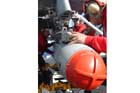
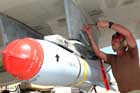
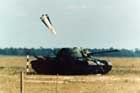
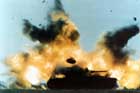
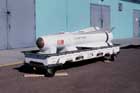
Description:
Mission: The
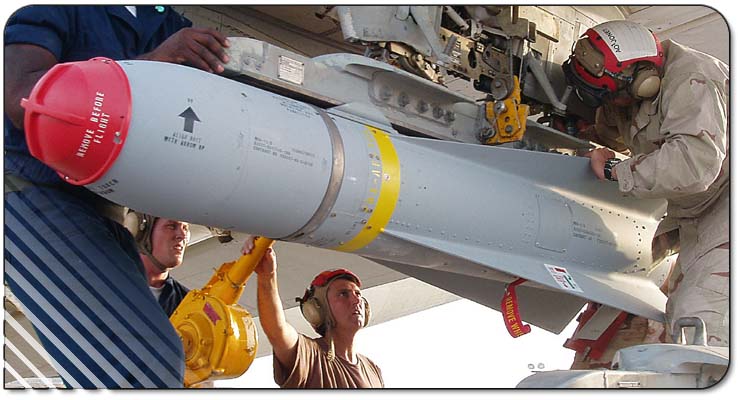
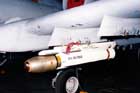
AGM-65 Maverick is a tactical,
air-to-surface
guided missile designed for close air support, interdiction and defense
suppression mission. It provides stand-off capability and high
probability of strike against a wide range of tactical targets,
including armor, air defenses, ships, transportation equipment and fuel
storage facilities.
Features: The
Maverick is a modular design weapon. A
different combination of the guidance package and warhead can be
attached to the rocket motor section to produce a different weapon. The
Maverick has three different seekers and two different warheads. The
solid-rocket motor propulsion section is common to all variants. The
seeker options are electro-optical (EO) imaging, imaging infrared (IR)
or a laser guidance package. The warhead is in the missile's center
section. Either a 125-pound shaped-charge warhead or a 300-pound
penetrator warhead can be used. A contact fuse in the nose fires the
shaped-charge warhead. The penetrator uses a delayed-fuse, allowing the
warhead to penetrate the target with its kinetic energy before firing.
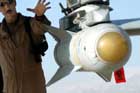
The latter is very effective against large, hard targets. The AGM-65
has a cylindrical body with long-chord delta wings and tail control
surfaces mounted close to the trailing edge of the wing of the aircraft
using it.
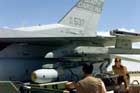
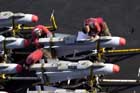
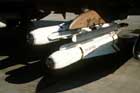
A-10, F-15E and F-16 aircraft carry Mavericks. As many as six Mavericks
can be carried by an aircraft, usually in three round, underwing
clusters, allowing the pilot to engage several targets on one mission.
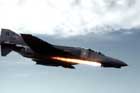
The missile also has "launch-and-leave" capability that enables a pilot
to fire it and immediately take evasive action or attack another target
as the missile guides itself to the target. Mavericks can be launched
from high altitudes to tree-top level and can hit targets ranging from
a distance of a few thousand feet to 13 nautical miles at medium
altitude.
Maverick B models have an electro-optical television guidance system.
After the protective dome cover is automatically removed from the nose
of the missile and its video circuitry activated, the scene viewed by
the guidance system appears on a cockpit television screen. The pilot
selects the target, centers cross hairs on it, locks on, and then
launches the missile. The Maverick B also has a screen magnification
capability that enables the pilot to identify and lock on smaller and
more distant targets.
The Maverick D has an imaging infrared guidance system, operated much
like that of the A and B models, except that infrared video overcomes
the daylight-only, adverse weather limitations of the other system. The
infrared Maverick D can track heat generated by a target and provide
the pilot a pictorial display of the target during darkness and hazy or
inclement weather.
The Maverick E model is the only version having the laser-guided seeker
section. It uses the heavyweight penetrator warhead. The U.S. Air Force
and Marine Corps are the users of this variant.
The Maverick F is a naval variant of the D/G model (IR) currently in
use by the U.S. Navy. It also uses the 300-pound penetrator warhead.
The Maverick G model essentially has the same guidance system as the D,
with some software modifications that track larger targets. The G
model's major difference is its heavyweight penetrator warhead, while
Maverick B and D models employ the shaped-charge warhead.
Maverick K models are currently in development. They were developed by
taking a G model and replacing the IR guidance system with an
electro-optical television guidance system.
Maverick K and H models are currently in production. The Maverick K
model was developed by taking a G model and replacing the IR guidance
system with an electro-optical television guidance system. The Maverick
H model was developed by taking a B model and upgrading it to increase
its capability.
Background: The Air
Force accepted the first AGM-65A
Maverick
in August 1972. A total of 25,750 A and B Mavericks were purchased by
the Air Force. Maverick A's have recently been phased out of the
inventory. The Air Force is exploring the possibility of converting
phased out A's and near obsolete B's and making an EO version to be
named AGM-65H. The software in the H would be upgraded increasing its
capability.
The Air Force took delivery of the first AGM-65D in October 1983, with
initial operational capability in February 1986. Delivery of
operational AGM-65G missiles took place in 1989.
More than 5,000 AGM-65 A/B/D/E/F/G's were employed during Operation
Desert Storm, mainly attacking armored targets. Mavericks played a
large part in the destruction of Iraq's significant military force.
|
|