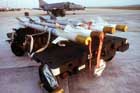
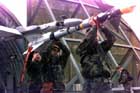
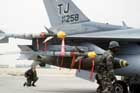
Description:
Mission: The
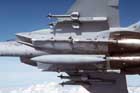
AIM-9 Sidewinder is a supersonic,
heat-seeking, air-to-air missile carried by fighter aircraft. It has a
high-explosive warhead and an infrared heat-seeking guidance system.
The Sidewinder was developed by the U.S. Navy for fleet air defense and
was adapted by the U.S. Air Force for fighter aircraft use. Early
versions of the missile were extensively used in the Southeast Asia
conflict.
Features: The AIM-9
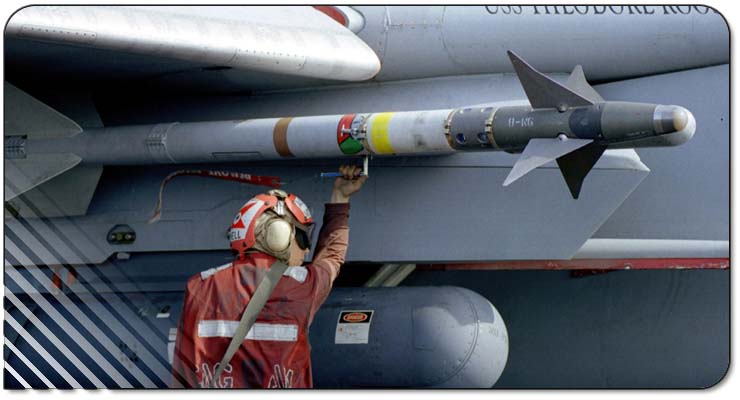
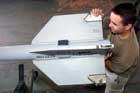
has a cylindrical body with a
roll-stabilizing rear wing/rolleron assembly. Also, it has detachable,
double-delta control surfaces behind the nose that improve the
missile's maneuverability. Both rollerons and control surfaces are in a
cross-like arrangement.
The missile's main components are an infrared homing guidance section,
an active optical target detector, a high-explosive warhead and a
rocket motor.
The infrared guidance head enables the missile to home in on target
aircraft engine exhaust. An infrared unit costs less than other types
of guidance systems, and can be used in day/night and electronic
countermeasures conditions. The infrared seeker also permits the pilot
to launch the missile, then leave the area or take evasive action while
the missile guides itself to the target.
Background: The
AIM-9A, a prototype of the Sidewinder,
was
first fired successfully in September 1953. The initial production
version, designated AIM-9B, entered the Air Force inventory in 1956 and
was effective only at close range. It could not engage targets close to
the ground, nor did it have nighttime or head-on attack capability.
These shortcomings were eliminated on subsequent versions.
The AIM-9J, a conversion of the AIM-B and E models, has maneuvering
capability for dogfighting, and greater speed and range, giving it
greater enhanced aerial combat capability. Deliveries began in 1977 to
equip the F-15 and other Sidewinder-compatible aircraft.
The AIM-9L added a more powerful solid-propellant rocket motor as well
as tracking maneuvering ability. An improved active optical fuse
increased the missile's lethality and resistance to electronic
countermeasures. A conical scan seeker increased seeker sensitivity and
improved tracking stability. The L model was the first Sidewinder with
the ability to attack from all angles, including head-on. Production
and delivery of the AIM-9L began in 1976.
The AIM-9P, an improved version of the J model, has greater engagement
boundaries, enabling it to be launched farther from the target. The
more maneuverable P model also incorporated improved solid-state
electronics that increased reliability and maintainability. Deliveries
began in 1978.
The AIM-9P-1 has an active optical target detector instead of the
infrared influence fuse; the AIM-9P-2 added a reduced-smoke motor. The
most recently developed version, the AIM-9P-3, combined both the active
optical target detector and the reduced-smoke motor. It also has added
mechanical strengthening to the warhead as well as the guidance and
control section. The improved warhead uses new explosive material that
is less sensitive to high temperature and has a longer shelf life.
The AIM-9M has the all-aspect capability of the L model, but provides
all-around higher performance. The M model has improved defense against
infrared countermeasures, enhanced background discrimination
capability, and a reduced-smoke rocket motor. These modifications
increase ability to locate and lock-on a target and decrease the
missile's chances for detection. Deliveries of the M model began in
1983.
The AIM-9M-9 has expanded infrared countermeasures detection circuitry.
AIM-9X is the newest variant of Sidewinder. The AIM-9X has the same
rocket motor and warhead as the AIM-9M. Major physical changes from
previous versions of the missile include fixed forward canards, and
smaller fins designed to increase flight performance. The guidance
section has been redesigned and features an imaging infrared seeker.
The propulsion section now incorporates a jet-vane steering system for
enhanced post-launch agility. The X model is also compatible with the
Joint Helmet-Mounted Cueing System, which is designed for ease of
target acquisition and decreased aircrew workload. |
|