<< Combat Index home
<< United States Aircraft:
Rockets and Space Index


US Rockets and Space Vehicles: Delta II Launch Vehicle

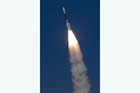
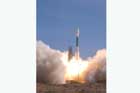
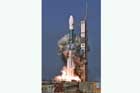
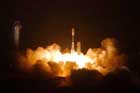
Delta II Launch Vehicle
Unofficial names/slang: n/a
Function: Space lift vehicle
Date deployed: November 26, 1990
Contractor: Boeing Company, Expendable Launch Systems
Unit cost: unavailable
Diameter: Fairing: 9' - 6"; Core: 8' - 0"
Wingspan: none
Height: 125' - 9"
Thrust at Liftoff: 699,250 lbs
Weight - max take-off: 511,190 lbs (231,870 kg)
Lift Capability: Up to 11,100 pounds (4,995 kilograms) into low earth orbit, 28-degree circular near-earth orbit and up to 8,420 pounds (3,789 kilograms) into a 90-degree polar orbit. Up to 4,010 pounds (1,804.5 kilograms) into geo-transfer orbit, approximately 12,000 miles [19,200 kilometers] and up to 2,000 pounds (909 kilograms) into geosynchronous orbit, approximately 22,000 miles (35,200 kilometers).
Payloads: Department of Defense Navstar Global Positioning System, NASA Mars probes and commercial satellites such as Iridium and Globalstar
Guidance System: Delta Redundant Inertial Flight Control Assembly manufactured by Allied Signal Aerospace
Engines (First Stage): (1) Rocketdyne RS-27 and (2) LR-101-NA-11 vernier engines; both use refined kerosene and liquid oxygen as its propellants @ 200,000 lbs thrust
Engines (First Stage): Restartable Aerojet AJ10-110K motor; uses nitrogen tetroxide and Aerozine 50 propellants @ 9,750 lbs thrust
Payload assist module: If used, Star-48B Solid-fuel Rocket @ 14,920 lbs thrust. (9) Alliant Techsystems strap-on graphite-epoxy motors surround the first stage for augmented lift-off @ 100,270 lbs thrust total

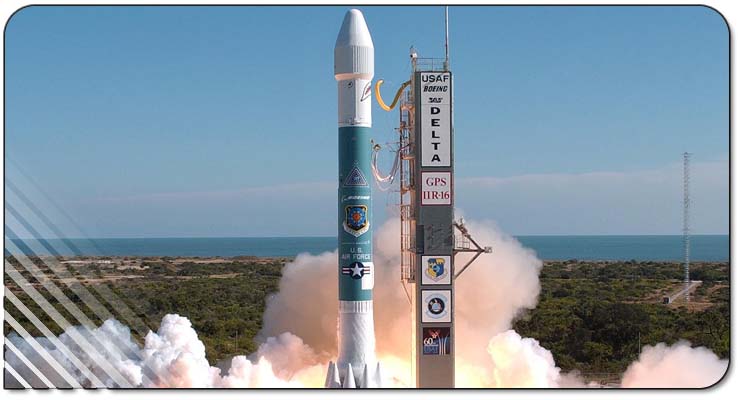
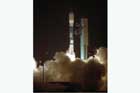
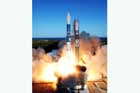
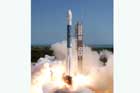
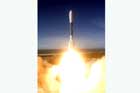
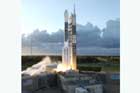
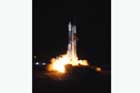
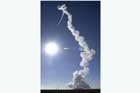
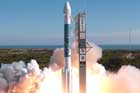
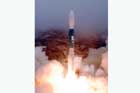
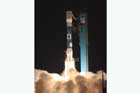
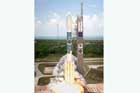
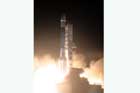
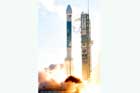
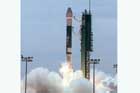
Mission: Delta II Launch Vehicle Mission The Delta II is an expendable launch, medium-lift vehicle used to launch Navstar Global Positioning System (GPS) satellites into orbit, providing navigational data to military users. Additionally, the Delta II launches civil and commercial payloads into low-earth, polar, geosynchronous transfer and stationary orbits.

Features: The Delta II stands a total height of 125.75 feet (38.32 meters). The payload fairing -- the shroud covering the third stage and the satellite -- is 2. 9 meters (9.5 feet) wide to accommodate the GPS satellite. A 3-meter (10 feet) stretched version fairing also is available for larger payloads. Six of the nine solid-rocket motors that ring the first stage separate after one minute of flight, and the remaining three ignite, then separate, after burn-out one minute later.

Background: The Delta launch vehicle family began in 1959 when NASA's Goddard Space Flight Center awarded a contract to Douglas Aircraft Company (now Boeing) to produce and integrate 12 space-launch vehicles. The Delta used components from the U.S. Air Force's Thor intermediate-range ballistic missile as its first stage and the U.S. Navy's Vanguard launch-vehicle program as its second. The first Delta was launched from Cape Canaveral Air Force Station, FL, on May 13, 1960 and had the ability to deliver a 100-pound spacecraft into geostationary transfer orbit.

In January 1987 the Air Force awarded a contract to McDonnell Douglas, now Boeing, for construction of 18 Delta IIs to launch Navstar GPS satellites, originally programmed for launch on the space shuttle. Since then, the order expanded to accommodate 28 GPS satellite-dedicated launch vehicles.

The first Delta II was successfully launched on Feb. 14, 1989, at Cape Canaveral. There are two primary versions of the Delta II (6925 and 7925). The Delta 6925, the first version, carried the initial nine GPS satellites into orbit.

Since May 1960, the Delta program has more than 270 successful military, civil and commercial launches. The Delta accomplished many firsts over the years. These include the first international satellite, Telstar I, in 1962; the first geosynchronous-orbit satellite, Syncorn II, in 1963; and the first commercial communications satellite, COMSAT I, in 1965.

The Delta II is launched primarily from Cape Canaveral AFS, but is also launched from Vandenberg Air Force Base, CA. Members of Air Force Space Command's 45th Space Wing, with headquarters at Patrick AFB, FL, and 30th Space Wing at Vandenberg are responsible for the Delta II's military launch missions.

Click on photos to enlarge
Delta II

Delta II

Delta II

Delta II

Delta II

Delta II

Delta II

Delta II

Delta II

Delta II

Delta II

Delta II

Delta II

Delta II

Delta II

Delta II

Delta II

Delta II

Delta II

Delta II

Delta II

Delta II

Delta II

Delta II

Delta II

Delta II

Delta II

Photos: US Military


More Photos: 1 | 2 | 3 | 4 | 5 | 6 | 7 | 8 | 9 | 10


COMBAT INDEX DATA STORE \

webmaster@combatindex.com