SITE NAVIGATION
SHIP SPECIFIC INFORMATION
| TYPE | AMPHIBOUS ASSAULT (LHD) |
| CLASS | WASP |
| OFFICIAL NAME | USS ESSEX |
| PENNANT NUMBER | 2 |
| NICKNAME | THE IRON GATOR |
| MOTTO | TAKE NOTICE |
| BUILDER | INGALLS SHIPBUILDING |
| CONTRACT AWARD DATE | 09/10/1986 |
| KEEL LAYING DATE | 03/20/1989 |
| LAUNCH DATE | 02/23/1991 |
| DELIVERY DATE | 07/10/1992 |
| COMMISSION DATE | 10/17/1992 |
| PLANNING YARD | NORFOLK NAVAL SHIPYARD, NORFOLK, VA |
| NAVSEA PMS | 470 |
| CUSTODIAN | US NAVY |
| STATUS | ACTIVE DUTY |
| HOMEPORT | SASEBO, JAPAN |
| MAILING ADDRESS | FPO, AP, 96643-1661 |
| UIC (UNIT IDENT. CODE) | 21533 |
| TYPE COMMANDER | SURFPAC |
| FLEET COMMAND | N/A |
| GROUP COMMAND | EXPSTRKGRU 7 |
| SQUADRON COMMAND | PHIBRON 11 |
AMPHIBIOUS ASSAULT SHIPS
.............................................


LHD 2 | USS ESSEX
Namesake:Legacy Name |
||||||||||||||||||||||
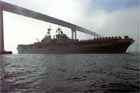
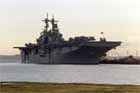
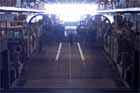
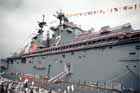
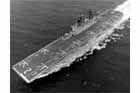
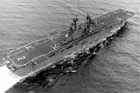
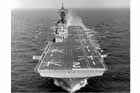
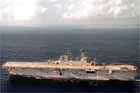
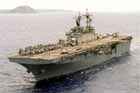
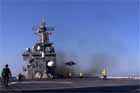
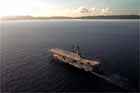
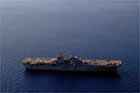
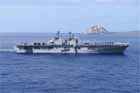
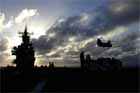
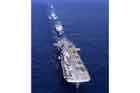
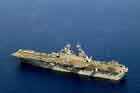
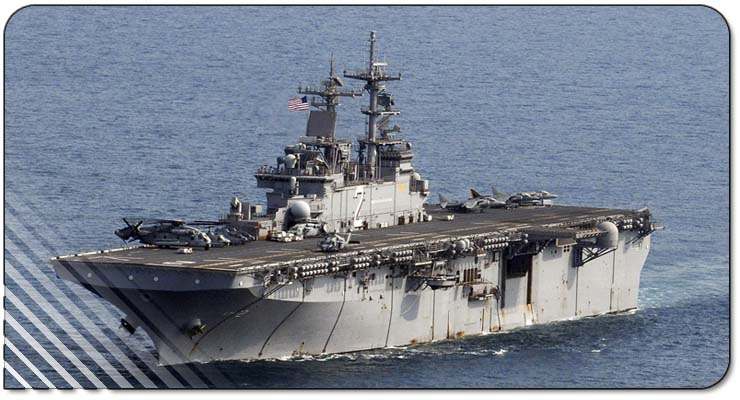
Mission:USS Essex (LHD 2) is the second ship to be commissioned in the WASP-class of multipurpose amphibious assault ships. The principle mission of Essex is to conduct prompt, sustained operations at sea, primarily as the centerpiece and flagship of the Amphibious Ready Group. LHDs provide the means to transport, deploy, command and support all elements of a Marine landing force of over 2,000 troops during an assault by air and amphibious craft. Designed to be versatile, Essex has the option of simultaneously using helicopters, Harrier jets, and Landing Craft Air Cushioned (LCAC), as well as conventional landing craft and assault vehicles in various combinations. LHDs missions, while operating with an aircraft carrier battle group. The ship's extensive medical facilities consist of six medical operating rooms, four dental operating rooms, medical laboratories and hospital facilities capable of caring for 600 patients. In carrying out its primary mission, the 844-foot long, 44,000-ton Essex will transport and land ashore troops, tanks, trucks, artillery, and other supplies necessary to support an assault. |
||||||||||||||||||||||
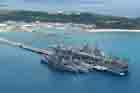
Historical Notes:After commissioning the ESSEX departed San Diego on her maiden deployment on October 25, 1994 during which, was a major participant in the withdrawal of the Multinational force from Somalia in Operation United Shield. On its second deployment the ship and embarked 11th Marine Expeditionary Unit participated in Operation Southern Watch/ Exercise; Eager Mace off the coast of Kuwait and Exercise; Tandem Thrust off the coast of Australia. In July 2000, ESSEX took part in the Navy's largest crew swap to date when she arrived in Sasebo, Japan to relieve the USS BELLEAU WOOD (LHA 3) which was forward deployed to Sasebo since the fall of 1992. The swap was part of a planned rotation of forward deployed naval forces in Japan, and was the third crew-swap exchange. The ships’ crews simply switched ships, minimizing the impact of moving families from homeport to homeport. Sailors in Sasebo assigned to USS BELLEAU WOOD, moved on to ESSEX, while Sailors from San Diego assigned to ESSEX moved aboard BELLEAU WOOD. BELLEAU WOOD and the San Diego-based crew then returned to San Diego in mid-August to begin overhaul and maintenance cycles. ESSEX departed San Diego in July 2000 to replace USS BELLEAU WOOD (LHA 3) successfully completing the largest hull swap in U. S. Navy history. ESSEX then inherited the distinctive role as the Navy’s only forward-deployed multi-purpose amphibious assault ship in Sasebo, Japan. In that role ESSEX provided Humanitarian Assistance and disaster relief operations to East Timor in October 2001. After completing Exercises Foal Eagle and Cobra Gold ESSEX departed in August 2004 for her fourth deployment with the 31st MEU (SOC). ESSEX served as Commander, Expeditionary Strike Group Three (ESG 3) flagship. While on deployment to the Arabian Gulf in January 2005, ESSEX received additional tasking to provide Humanitarian Assistance and Disaster Relief in Indonesia for the victims of the Tsunami. ESSEX was again deployed for Humanitarian Assistance in February 2006 helping the survivors of the Leyte mudslide in the Philippines. In March 2006 ESSEX arrived at Iwo Jima to participate in the 61st Anniversary of the historic World War II Battle. ESSEX was called upon in November 2006 to provide security, medical and communication support to the President of the United States during his visit to the Western Pacific. Continuing to lead U.S. Navy’s strategic engagement initiative, in 2007 ESSEX successfully conducted combined operations with the Republic of Korea, the Republic of the Philippines, and Australia. ESSEX capped off her 2007 deployment schedule with a historic visit to the Kingdom of Cambodia. ESSEX’ visit to Cambodia marked the first time an amphibious assault ship has ever visited the country. In 2008 ESSEX once again conducted annual training exercises with the partner nations of the Republic of the Philippines, the Kingdom of Thailand and the Republic of Korea. Early in 2008 ESSEX was called upon to be in position to render aid to Burma in the wake of Cyclone Nargis. ESSEX remained on station for over three weeks, prepared to render aid but were rebuffed by the ruling government. Early 2009, ESSEX completed a successful exercise Cobra Gold, which had been cut short the previous year. ESSEX followed this with exercise Balikatan with the Republic of the Philippines. ESSEX then got underway in support of exercise Talisman Saber 2009 and conducted various welldeck and flight deck evolutions in support of this joint bi-lateral exercise between the U.S. and Australian military forces. Since her commissioning, ESSEX has received seven Battle Efficiency awards and numerous other awards, including all of the warfare excellence awards, numerous Golden Anchor awards for retention, and two Ney awards for food service excellence. |
||||||||||||||||||||||
Ship's Crest:
|
||||||||||||||||||||||
PHOTOS
|
 Supporters:
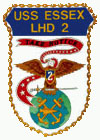
The amphibious insignia over the Pacific Ocean symbolizes amphibious
operations from the oceans of the world.
Supporters:
The amphibious insignia over the Pacific Ocean symbolizes amphibious
operations from the oceans of the world.